

Baguette Diamond Ring: The Design Logic Behind Zyra
etBri Team
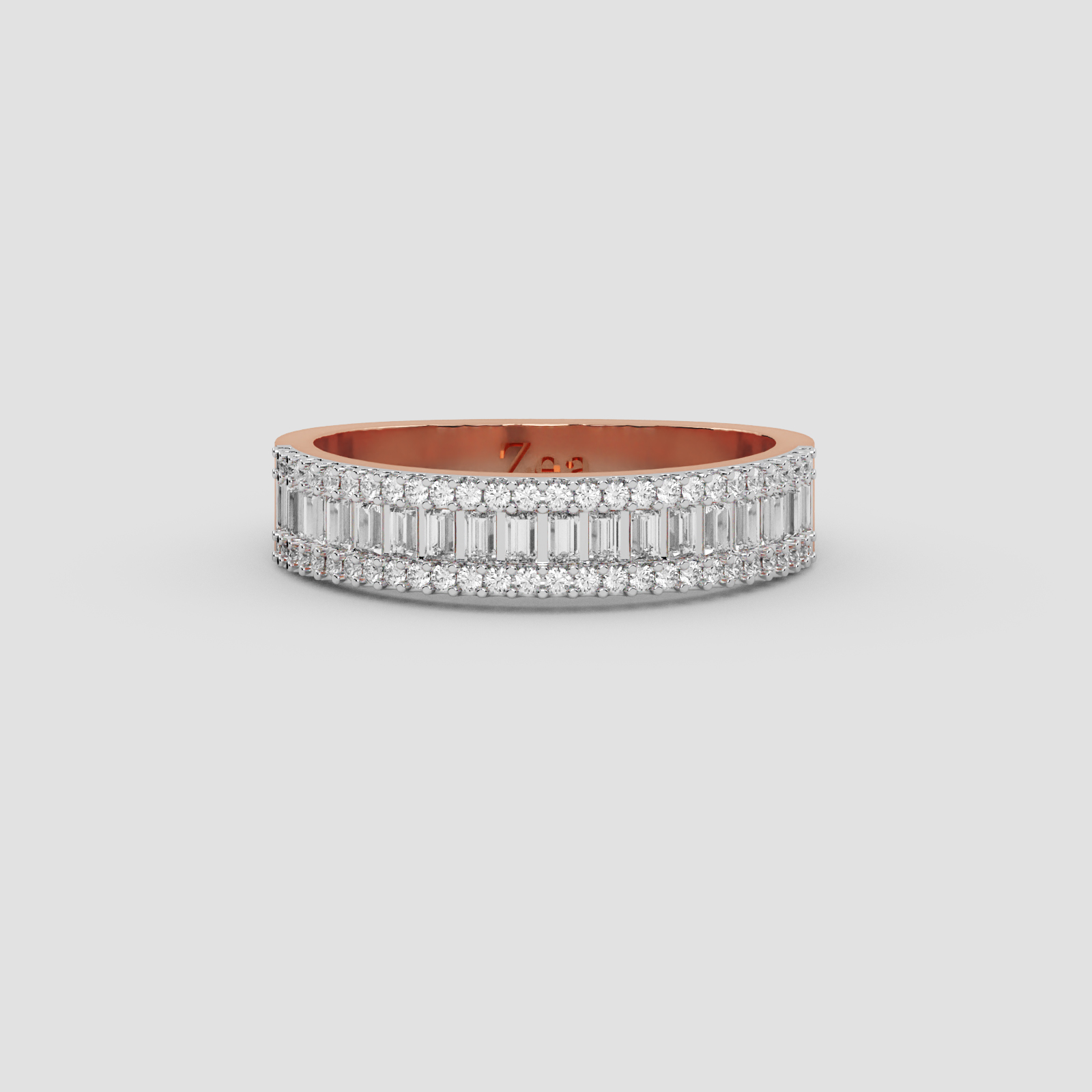
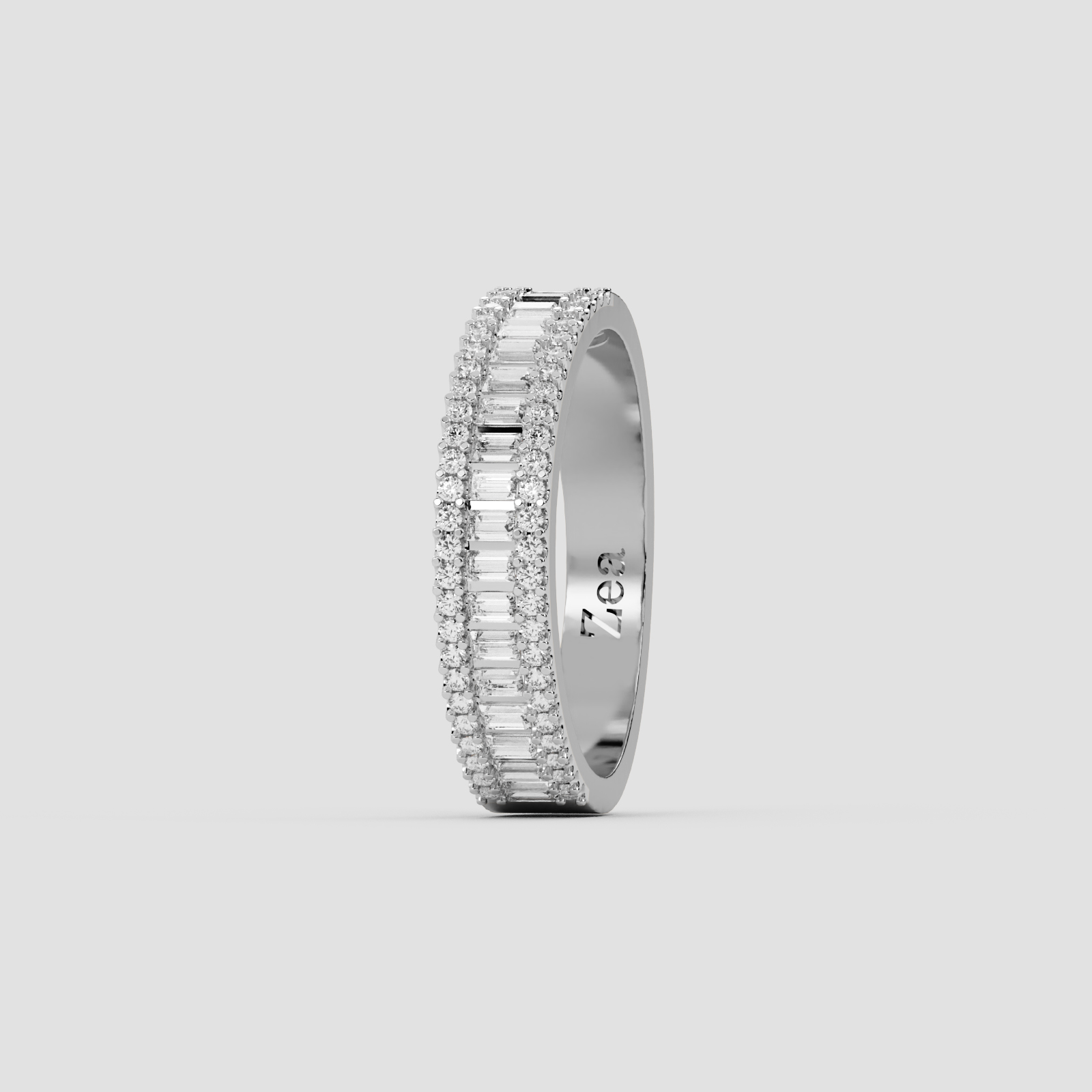
Most band rings fail at the same point. They stack stones without architectural logic. They treat diamonds as decoration rather than structure. The result is jewelry that sparkles without coherence — pieces that feel assembled rather than designed. The baguette diamond ring in the Zyra collection exists because we needed to answer a specific question: how do you create visual density without visual noise? How do you make seventy diamonds feel like one continuous gesture? This was the problem. The solution required rethinking how linear and circular elements interact within a single band. It required understanding that a geometric diamond ring must earn its geometry through deliberate placement, not decorative arrangement. The baguette cut emerged in the 1920s as a deliberate rejection of radiant excess. While round brilliants fracture light into scattered fire, the baguette contains it. The light moves in long, clean corridors. It suggests control. This is not a nostalgic choice. The baguette remains relevant because its values remain relevant. It speaks to buyers who trust restraint. The diamond band ring category is crowded with pieces that look similar at first glance but differ fundamentally in construction. Most fail in predictable ways. These shortcuts create jewelry that photographs well but wears poorly. The modern diamond ring buyer notices the difference within months. We designed around these failures. A channel set diamond ring solves the prong problem entirely. But channel setting is not merely a setting — it is an architectural commitment that shapes everything else about the piece. In this design, eighteen baguette diamonds sit within precision-milled channels. The metal walls hold each stone along its full length. No claws interrupt the surface. No prongs create height variation. The band reads as a continuous ribbon of alternating metal and stone. But baguettes alone would create a rigid visual. Light would move in parallel lines with no counterpoint. This is why fifty-two round-cut diamonds interrupt that linearity. Each round stone introduces radial light behaviour — small bursts of scattered brilliance that soften the baguette corridors without disrupting them. The silhouette emerged from testing how these two behaviours interact. Too many rounds and the precision dissolves. Too few and the band feels severe. At 0.41 carats of baguette weight and 0.19 carats of round weight, the ratio holds. The linear dominates. The radial punctuates. Weight distribution was calculated against finger comfort. A diamond band ring worn daily must not feel top-heavy. The channel walls carry structural load while remaining thin enough to avoid bulk. The result is a ring that sits stable on the hand without the heft that causes rotation. The modern baguette and round diamond ring depends on calibrated stone sizes. Larger baguettes would require deeper channels, adding band thickness. Smaller baguettes would lose the architectural presence that makes this design work. At 0.41 carats distributed across eighteen stones, each baguette averages just over 0.02 carats. This is small enough for sleek proportion but large enough for visible facet structure. The step-cut facets — long parallel planes — create hall-of-mirrors depth when viewed straight on. The fifty-two round diamonds totalling 0.19 carats function differently. Their brilliant-cut faceting breaks light into smaller fragments. They are not meant to dominate. They provide texture against the baguette smoothness. All diamonds carry IGI or SGL certification. This matters because mixed-cut designs present grading complexity. Baguettes reveal inclusions that round brilliants might hide. Certification ensures each stone meets documented standards for clarity and colour, regardless of cut behaviour. The baguette diamond band ring for women in this collection represents considered proportion — enough carat weight to register as substantial, not so much that the ring becomes an occasion-only piece. Gold purity is not a quality hierarchy. It is a set of trade-offs that suit different intentions. This ring is available in 10 Kt, 14 Kt, and 18 Kt — each certified with BIS hallmark for verified gold content. Each purity serves a purpose. None is superior. The choice depends on how the ring will live. Metal colour transforms how diamonds present. The same seventy stones read differently depending on the gold alloy surrounding them. Explore the full Zyra collection to see how each metal colour translates across different silhouettes and stone arrangements. Informed purchasing requires attention to specific details. A channel set diamond band ring involves construction techniques that vary between makers. These verification points distinguish jewelry that performs from jewelry that merely appears. Channel settings trap less debris than prong settings but still require care. Baguettes with their open facets show residue more readily than brilliant cuts. Styling a geometric diamond ring benefits from restraint. The design carries complexity internally. The design alternates eighteen baguette diamonds with fifty-two round diamonds in continuous channels. This creates directional light movement interrupted by radial bursts — a deliberate contrast between linear precision and scattered brilliance. Standard bands typically use uniform cuts without this architectural interplay. Channel setting protects stones from the impacts that damage prong-set rings during daily wear. In 10 Kt or 14 Kt gold, the band resists scratching and deformation through regular activity. The smooth surface reduces snagging on fabrics or catching on objects. 10 Kt offers maximum durability for continuous wear with lighter colour. 14 Kt balances resilience with richer hue for everyday fine jewelry. 18 Kt delivers deepest colour saturation and material prestige, suited for special occasions or buyers prioritising gold content over hardness. IGI and SGL certifications document each diamond's carat weight, cut quality, clarity grade, and colour grade through independent laboratory assessment. This ensures the seventy diamonds in this band meet stated specifications. BIS hallmark separately certifies gold purity. Consider skin undertone and wardrobe palette. Rose gold warms and softens. White gold neutralises and sharpens. Yellow gold enriches and signals tradition. Each metal changes how the baguette and round diamonds interact with light and skin. The Zyra collection builds jewelry that respects both material and wearer. This baguette diamond ring holds seventy certified stones in channels engineered for decades of continuous wear. The geometry is deliberate. The proportion is tested. The result is a band that performs as designed, across any metal colour, at any purity. Shop now or explore the Zyra collection to find the piece that aligns with intention.What the Baguette Form Has Always Meant
Where Most Diamond Band Rings Compromise
The Structural Decisions That Define This Band
Stone Shapes and the Logic of 0.60 Total Carat Weight
How Karat Purity Reshapes This Design

Rose Gold, White Gold, Yellow Gold: Three Distinct Expressions
What to Verify Before Purchasing a Channel Set Band
Maintenance and Styling for Geometric Band Rings
Frequently Asked Questions
What makes the geometric baguette diamond ring design distinct from standard bands?
Can a baguette diamond ring be worn every day?
Which karat purity works best for different purposes?
What do IGI and SGL certifications verify?
How should buyers choose between rose gold, white gold, and yellow gold?